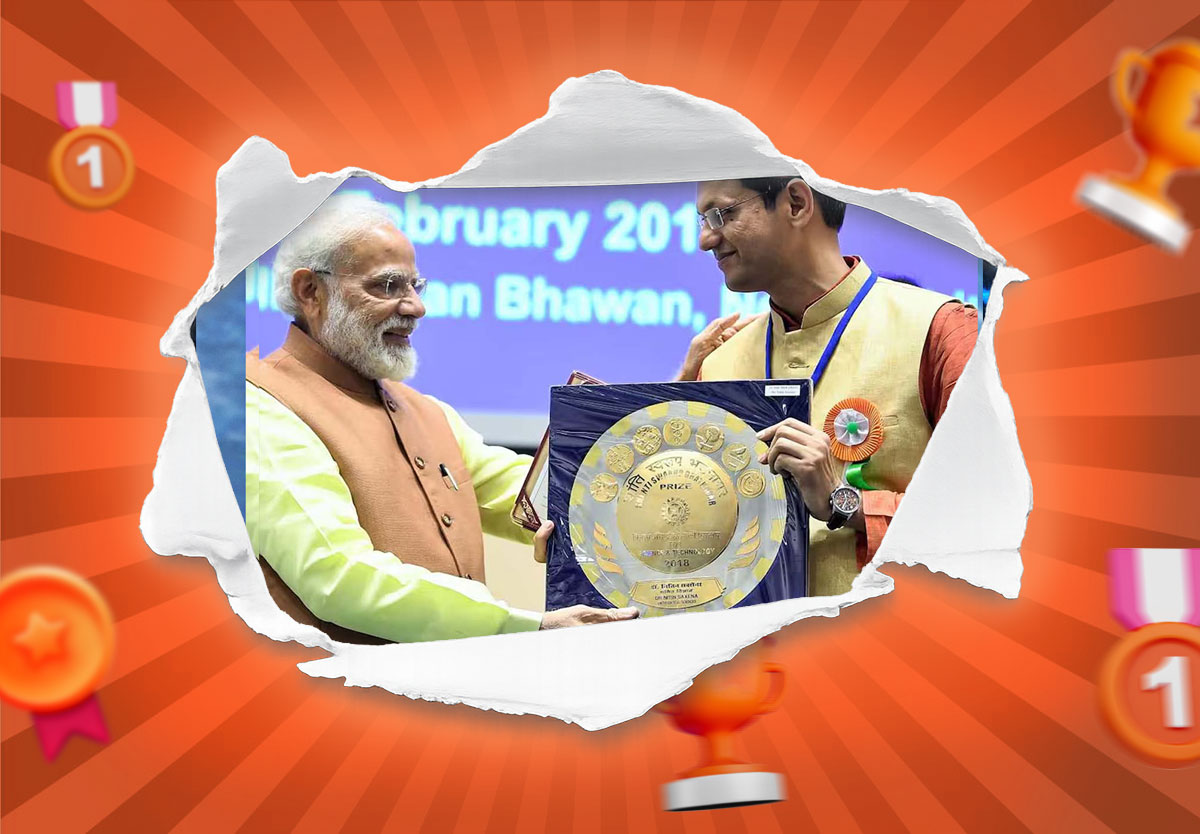
About Shanti Swarup Bhatnagar Prize
The Shanti Swarup Bhatnagar Prize for Science and Technology (SSB) was a science award in India given annually by the Council of Scientific and Industrial Research (CSIR) for notable and outstanding research, applied or fundamental, in six categories. It was the highest, most prestigious and coveted prize given in the area of multidisciplinary science in India.
The award is named after the founder Director of the Council of Scientific & Industrial Research (CSIR) India, the late Dr (Sir) Shanti Swarup Bhatnagar and is known as the ‘Shanti Swarup Bhatnagar (SSB) Prize for Science and Technology’. The Prize is given each year for outstanding contributions to science and technology.
List of Shanti Swarup Bhatnagar Prize Winners 1961 - 1970
From 1961 - 1970 the Council of Scientific and Industrial Research (CSIR), Government of India announced total 52 winners/recipients. Here is the list of the 52 Shanti Swarup Bhatnagar Prize for Science and Technology award winners from 1961 - 1970:
| Year | Winner Name | State/Country | Field |
|---|---|---|---|
| 1961 | Monkombu Sambasivan Swaminathan | Tamil Nadu | Genetics |
| 1962 | Bimal Kumar Bachhawat | West Bengal | Glycobiology |
| 1963 | Jagannath Ganguly | West Bengal | Biochemistry |
| 1964 | Dilbagh Singh Athwal | Punjab | Plant breeding |
| 1965 | C. V. Subramanian | Tamil Nadu | Mycology |
| 1966 | Neelamraju Ganga Prasada Rao | Andhra Pradesh | Genetics |
| 1966 | Hari Krishan Jain | Delhi | Cytogenetics |
| 1967 | Arun Kumar Sharma | Delhi | Cytogenetics |
| 1968 | T. A. Venkitasubramanian | Delhi | Biochemistry |
| 1961 | Asima Chatterjee | West Bengal | Phytomedicine |
| 1962 | Sasanka Chandra Bhattacharyya | West Bengal | Organic chemistry |
| 1963 | Bal Dattatreya Tilak | Maharashtra | Heterocyclic chemistry |
| 1964 | Sukh Dev | Punjab | Organic chemistry |
| 1965 | Sadhan Basu | West Bengal | Polymer chemistry |
| 1965 | Ram Charan Mehrotra | Uttar Pradesh | Organometallic chemistry |
| 1966 | N. A. Ramaiah | Andhra Pradesh | Sugar chemistry |
| 1967 | Mushi Santappa | Andhra Pradesh | Physical chemistry |
| 1968 | Chintamani Nagesa Ramachandra Rao | Karnataka | Solid state chemistry |
| 1969 | Amolak Chand Jain | Delhi | Bioorganic chemistry |
| 1970 | P. T. Narasimhan | North Dakota | Theoretical chemistry |
| 1962 | Man Mohan Suri | Punjab | Suri-transmission |
| 1963 | Brahm Prakash | Punjab | Metallurgy |
| 1964 | Bal Raj Nijhawan | Uttar Pradesh | Metallurgical engineering |
| 1965 | Ayyagari Sambasiva Rao | Telangana | Electronic engineering |
| 1966 | Jai Krishna | Uttar Pradesh | Earthquake engineering |
| 1967 | Tanjore Ramachandra Anantharaman | Tamil Nadu | Metallurgy |
| 1968 | Kshitish Ranjan Chakravorty | West Bengal | Fertilizer science |
| 1965 | Kollagunta Gopalaiyer Ramanathan | Andhra Pradesh | Number theory |
| 1961 | Ram Behari Arora | Rajasthan | Cardiovascular pharmacology |
| 1963 | Bal Krishan Anand | Uttar Pradesh | Neurophysiology |
| 1963 | Sibte Hasan Zaidi | Uttar Pradesh | Toxicology |
| 1965 | Vulimiri Ramalingaswami | Andhra Pradesh | Pathology |
| 1965 | Nirmal Kumar Dutta | West Bengal | Microbiology |
| 1966 | Jyoti Bhusan Chatterjea | West Bengal | Haemoglobinopathy |
| 1966 | Rustom Jal Vakil | Maharashtra | Cardiology |
| 1967 | M. J. Thirumalachar | North Dakota | Mycology |
| 1967 | Ajit Kumar Basu | West Bengal | Cardiac surgery |
| 1968 | Uttamchand Khimchand Sheth | Maharashtra | Neurobiology |
| 1968 | Sarashi Ranjan Mukherjee | West Bengal | Pharmacology |
| 1969 | Ranjit Roy Chaudhury | Bihar | Pharmacology |
| 1969 | Subramanian Kalyanaraman | Tamil Nadu | Neurosurgery |
| 1961 | Gopalasamudram Narayana Ramachandran | Tamil Nadu | Ramachandran plot |
| 1962 | Vikram Ambalal Sarabhai | Gujarat | Space science |
| 1963 | Raja Ramanna | Karnataka | Nuclear physics |
| 1964 | Ajit Ram Verma | Uttar Pradesh | Crystallography |
| 1965 | Barry Ramachandra Rao | Andhra Pradesh | Crystallography |
| 1966 | Sivaraj Ramaseshan | Tamil Nadu | Crystallography |
| 1966 | S. C. Jain | Uttar Pradesh | Semiconductor devices |
| 1967 | Devendra Lal | Uttar Pradesh | Geophysics |
| 1968 | Ashesh Prasad Mitra | West Bengal | Environmental physics |
| 1969 | Asoke Nath Mitra | Mymensingh | Particle physics |
| 1970 | Vainu Bappu | Andhra Pradesh | Astrophysics |
Frequently Asked Questions
State/Country Chart
Award research specialist focused on news analysis, fact-checking, and creating accurate content about national and international awards.
Rohit Chauhan has extensive experience in researching awards, honors, recognitions, and achievement-based news. He specializes in verifying information from trusted sources, analyzing award records, and creating well-structured, informative content for readers. His work focuses on delivering accurate and up-to-date information about award winners, award histories, nominations, and notable achievements across various fields.