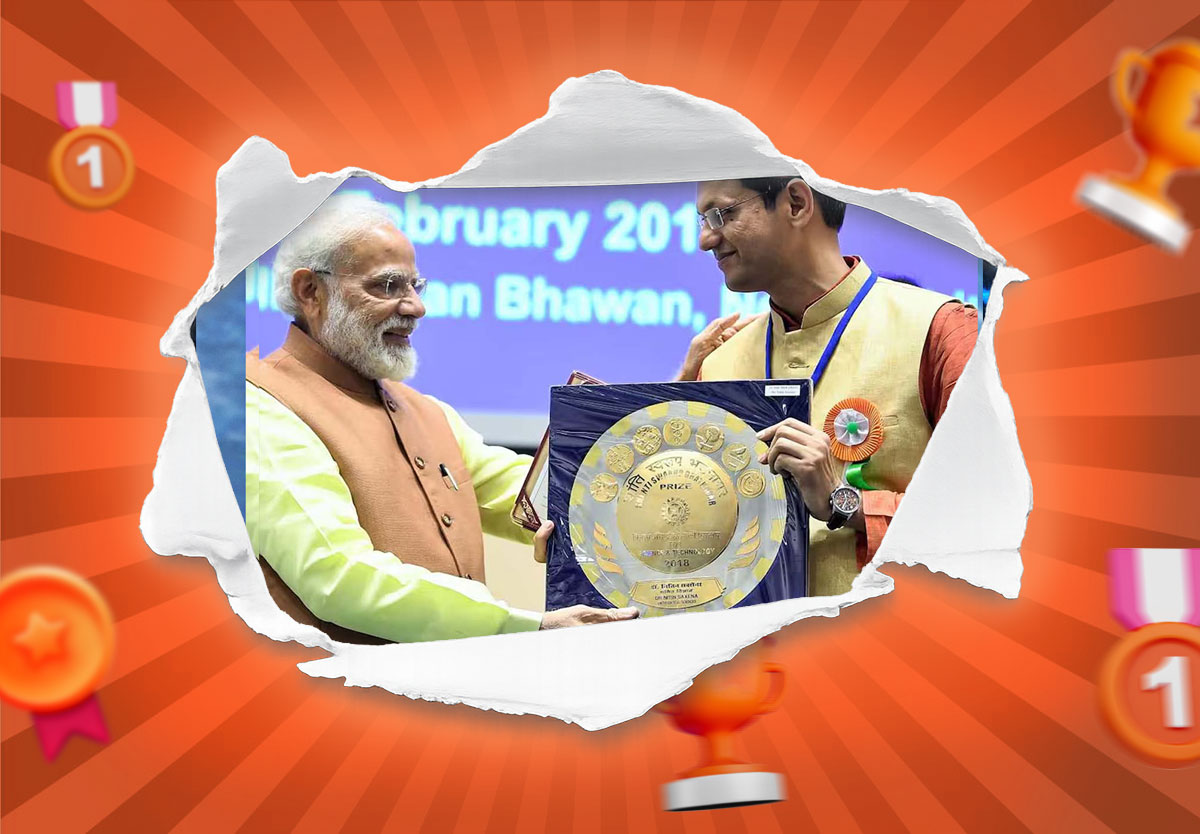
About Shanti Swarup Bhatnagar Prize
The Shanti Swarup Bhatnagar Prize for Science and Technology (SSB) was a science award in India given annually by the Council of Scientific and Industrial Research (CSIR) for notable and outstanding research, applied or fundamental, in six categories. It was the highest, most prestigious and coveted prize given in the area of multidisciplinary science in India.
The award is named after the founder Director of the Council of Scientific & Industrial Research (CSIR) India, the late Dr (Sir) Shanti Swarup Bhatnagar and is known as the ‘Shanti Swarup Bhatnagar (SSB) Prize for Science and Technology’. The Prize is given each year for outstanding contributions to science and technology.
List of Shanti Swarup Bhatnagar Prize Winners 2011 - 2020
From 2011 - 2020 the Council of Scientific and Industrial Research (CSIR), Government of India announced total 111 winners/recipients. Here is the list of the 111 Shanti Swarup Bhatnagar Prize for Science and Technology award winners from 2011 - 2020:
| Year | Winner Name | State/Country | Field |
|---|---|---|---|
| 2011 | Amit Prakash Sharma | Delhi | Structural biology |
| 2011 | Rajan Sankaranarayanan | Tamil Nadu | Molecular biology |
| 2012 | Shantanu Chowdhury | West Bengal | Genomics |
| 2012 | Suman Kumar Dhar | West Bengal | Molecular biology |
| 2013 | Sathees Chukkurumbal Raghavan | Kerala | Biophysics |
| 2014 | Roop Mallik | Uttar Pradesh | Biophysics |
| 2015 | Balasubramanian Gopal | Karnataka | Biophysics |
| 2015 | Rajeev Kumar Varshney | Uttar Pradesh | Genetics |
| 2016 | Rishikesh Narayanan | Karnataka | Neuroscience |
| 2016 | Suvendra Nath Bhattacharyya | West Bengal | Molecular biology |
| 2017 | Deepak T. Nair | Kerala | Plant pathology |
| 2017 | Sanjeev Das | West Bengal | Cancer biology |
| 2018 | Thomas J. Pucadyil | Maharashtra | Membrane biochemistry |
| 2018 | Ganesh Nagaraju | Karnataka | DNA repair |
| 2019 | Soumen Basak | West Bengal | Immunology |
| 2019 | Kayarat Saikrishnan | Maharashtra | Structural biology |
| 2020 | Subhadeep Chatterjee | West Bengal | Molecular microbiology and host–pathogen interaction |
| 2020 | Vatsala Thirumalai | Tamil Nadu | Neuroscience |
| 2011 | Garikapati Narahari Sastry | Andhra Pradesh | Computational chemistry |
| 2011 | Balasubramanian Sundaram | Karnataka | Computational chemistry |
| 2012 | Gangadhar J. Sanjayan | Kerala | Bioorganic chemistry |
| 2012 | Govindasamy Mugesh | Tamil Nadu | Medicinal chemistry |
| 2013 | Yamuna Krishnan | Karnataka | Organic chemistry |
| 2014 | Souvik Maiti | West Bengal | Biophysical chemistry |
| 2014 | Kavirayani Ramakrishna Prasad | Karnataka | Organic chemistry |
| 2015 | D. Srinivasa Reddy | Andhra Pradesh | Medicinal chemistry |
| 2015 | Pradyut Ghosh | West Bengal | Inorganic chemistry |
| 2016 | Partha Sarathi Mukherjee | West Bengal | Supramolecular chemistry |
| 2017 | G. Naresh Patwari | Telangana | Spectroscopy |
| 2018 | Rahul Banerjee | West Bengal | Structural chemistry |
| 2018 | Swadhin Kumar Mandal | West Bengal | Organometallic chemistry |
| 2019 | Raghavan B. Sunoj | Kerala | Theoretical and computational organic chemistry |
| 2019 | Tapas Kumar Maji | West Bengal | Inorganic and material chemistry |
| 2020 | Subi George | Kerala | Supramolecular chemistry |
| 2020 | Jyotirmayee Dash | West Bengal | Organic synthesis and chemical biology |
| 2011 | Shankar Doraiswamy | Karnataka | Oceanography |
| 2014 | Sachchida Nand Tripathi | Uttar Pradesh | Atmospheric sciences |
| 2015 | Jyotiranjan Srichandan Ray | Odisha | Geochemistry |
| 2016 | Sunil Kumar Singh | Gujarat | Geochemistry |
| 2017 | S. Suresh Babu | Kerala | Atmospheric aerosols |
| 2018 | Parthasarathi Chakraborty | West Bengal | Environmental geochemistry |
| 2018 | Madineni Venkat Ratnam | Andhra Pradesh | Atmospheric sciences |
| 2019 | Subimal Ghosh | Maharashtra | Indian monsoon, hydro-meteorology and hydrology |
| 2020 | Abhijit Mukherjee | West Bengal | Hydrogeology, water policy |
| 2020 | Suryendu Dutta | West Bengal | Organic geochemistry |
| 2011 | Sirshendu De | West Bengal | Chemical engineering |
| 2011 | Upadrasta Ramamurty | Andhra Pradesh | Materials engineering |
| 2012 | N. Ravishankar | Karnataka | Nanostructured materials |
| 2012 | Shanthi Pavan | Tamil Nadu | VLSI design |
| 2013 | Bikramjit Basu | West Bengal | Ceramic engineering |
| 2013 | Suman Chakraborty | West Bengal | Nanofluids |
| 2014 | S. Venkata Mohan | Andhra Pradesh | Environmental engineering |
| 2014 | Soumen Chakrabarti | West Bengal | Computer science |
| 2015 | Yogesh M. Joshi | Maharashtra | Rheology |
| 2016 | Avinash Kumar Agarwal | Rajasthan | Mechanical engineering |
| 2016 | Venkata Padmanabhan | Karnataka | Computer science |
| 2017 | Aloke Paul | West Bengal | Materials engineering |
| 2017 | Neelesh B. Mehta | Karnataka | Wireless communications |
| 2018 | Amit Agrawal | Maharashtra | Fluid mechanics |
| 2018 | Ashwin Gumaste | Maharashtra | Telecom networks |
| 2019 | Manik Varma | Delhi | Machine learning, computer vision and computational advertising |
| 2020 | Amol Arvindrao Kulkarni | Maharashtra | Multiphase reactors and microreactors |
| 2020 | Kinshuk Dasgupta | West Bengal | Material science, nanotechnology |
| 2011 | Mahan Mitra | West Bengal | Hyperbolic geometry |
| 2011 | Palash Sarkar | West Bengal | Cryptology |
| 2012 | Siva Athreya | Karnataka | Probability theory |
| 2012 | Debashish Goswami | West Bengal | Noncommutative geometry |
| 2013 | Eknath Prabhakar Ghate | Maharashtra | Number theory |
| 2014 | Kaushal Kumar Verma | Karnataka | Complex analysis |
| 2015 | K. Sandeep | Karnataka | Elliptic partial differential equation |
| 2015 | Ritabrata Munshi | West Bengal | Number theory |
| 2016 | Amlendu Krishna | Maharashtra | Algebraic geometry |
| 2016 | Naveen Garg | Delhi | Theoretical computer science |
| 2018 | Amit Kumar | Delhi | Theoretical computer science |
| 2018 | Nitin Saxena | Uttar Pradesh | Theoretical computer science |
| 2019 | Dishant Mayurbhai Pancholi | Gujarat | Contact and symplectic topology |
| 2019 | Neena Gupta | West Bengal | Commutative algebra and affine algebraic geometry |
| 2020 | Rajat Subhra Hazra | West Bengal | Operator algebra and extreme value theory |
| 2020 | U. K. Anandavardhanan | Kerala | Number theory |
| 2011 | K. Narayanaswamy Balaji | Karnataka | Mycology |
| 2012 | Sandip Basu | Maharashtra | Nuclear medicine |
| 2013 | Pushkar Sharma | Uttar Pradesh | Immunology |
| 2014 | Anurag Agrawal | Delhi | Lung diseases |
| 2015 | Vidita Ashok Vaidya | Maharashtra | Neurosciences |
| 2016 | Niyaz Ahmed | Telangana | Molecular epidemiology |
| 2017 | Amit Dutt | Maharashtra | Genomics |
| 2017 | Deepak Gaur | Delhi | Vaccine development |
| 2018 | Ganesan Venkatasubramanian | Karnataka | Psychiatry |
| 2019 | Dhiraj Kumar | Delhi | Immunology, cell biology |
| 2019 | Mohammad Javed Ali | Andhra Pradesh | Dacryology |
| 2020 | Bushra Ateeq | Uttar Pradesh | Molecular oncology |
| 2020 | Ritesh Agarwal | Chandigarh | Allergic bronchopulmonary aspergillosis (ABPA) |
| 2011 | Shiraz Minwalla | Maharashtra | String theory |
| 2012 | Arindam Ghosh | West Bengal | Semiconductors |
| 2012 | Krishnendu Sengupta | West Bengal | Theoretical physics |
| 2013 | Amol Dighe | Maharashtra | High energy physics |
| 2013 | Vijay Balakrishna Shenoy | Karnataka | Condensed matter physics |
| 2014 | Pratap Raychaudhuri | West Bengal | Superconductivity |
| 2014 | Sadiqali Abbas Rangwala | Maharashtra | Optical physics |
| 2015 | Bedangadas Mohanty | Odisha | High energy physics |
| 2015 | Mandar Madhukar Deshmukh | Maharashtra | Mesoscopic physics |
| 2016 | S. Anantha Ramakrishna | Odisha | Condensed matter physics |
| 2016 | Sudhir Kumar Vempati | Karnataka | High-energy physics |
| 2017 | Nissim Kanekar | Maharashtra | Astronomy |
| 2017 | Vinay Gupta | Rajasthan | Materials science |
| 2018 | Aditi De | West Bengal | Quantum information & computing |
| 2018 | Ambarish Ghosh | West Bengal | Nano-science |
| 2019 | Aninda Sinha | West Bengal | Theoretical physics |
| 2019 | Shankar Ghosh | West Bengal | Experimental condensed matter physics |
| 2020 | Surajit Dhara | West Bengal | Soft matter physics, optics |
| 2020 | Rajesh Ganapathy | Karnataka | Soft condensed matter physics |
Frequently Asked Questions
State/Country Chart
Award research specialist focused on news analysis, fact-checking, and creating accurate content about national and international awards.
Rohit Chauhan has extensive experience in researching awards, honors, recognitions, and achievement-based news. He specializes in verifying information from trusted sources, analyzing award records, and creating well-structured, informative content for readers. His work focuses on delivering accurate and up-to-date information about award winners, award histories, nominations, and notable achievements across various fields.